
By Daniel Brasse, Aikido By the Bay
“Aikido is a mirror to yourself.”
Those words are often attributed to the late Morihiro Saito Sensei, and after more than three decades of training, I have found them to be profoundly true. People often say that Aikido is for everyone. In many ways, it is. Young or old, athletic or not, beginner or experienced, anyone can step onto the mat and begin training.
But there is another side to that statement.
Aikido is for everyone, but not everyone is ready for Aikido.
What do I mean by that?
Unlike many activities where success can be measured by points, trophies, or rankings, Aikido has a way of revealing who we really are. The dojo becomes a mirror. It reflects our habits, our attitudes, our patience, our fears, our ego, and our willingness to learn.
Sometimes what we see in that mirror is uncomfortable.
Over the years, I have watched children walk into the dojo and be genuinely surprised by something as simple as saying hello when they enter the room. Others are caught off guard when they are expected to bow, listen without interrupting, say “please” and “thank you,” help maintain and clean the dojo, or show respect to their training partners.
These are not difficult skills.
Yet for some, they are unfamiliar.
The same is true for adults. Many arrive expecting to learn self-defense techniques but quickly discover that the deeper lessons have little to do with throws and pins. They are asked to slow down, to listen, to be patient with themselves, to accept correction without becoming defensive, and to persevere when progress feels slow.
Aikido quietly asks us an important question:
Can you be taught?
One of the most profound lessons in Aikido comes through our training partners.
In training, our partner becomes our mirror.
When techniques are not working, it is easy to believe that the other person is resisting, blocking us, or making the movement difficult. Yet, more often than not, what we are experiencing is our own tension, our own impatience, or our own desire to force an outcome.
We feel a collision and assume the problem is in front of us.
In reality, we are often running into our own force.
The harder we push, the more resistance we create. The more attached we become to “making the technique work,” the further we move away from the principles Aikido is trying to teach us.
Our partners reveal things about ourselves that we may not otherwise see. They expose our habits. They reveal our frustration. They show us where we are rigid, where we are impatient, and where our ego gets involved.
The partner standing across from us is not the obstacle.
More often than not, they are the mirror.
For children, this may be one of the greatest gifts martial arts can provide.
In a world increasingly built around convenience, instant gratification, and constant entertainment, learning discipline has become a rare opportunity. So has learning respect, accountability, resilience, and gratitude.
When a child learns to greet others respectfully, make eye contact, listen attentively, and contribute to a group, they are developing skills that will serve them for the rest of their lives. These habits may seem small, but their impact is enormous.
The child who learns respect becomes the adult who earns trust.
The child who learns perseverance becomes the adult who overcomes challenges.
The child who learns accountability becomes the adult others can depend on.
Parents often enroll their children hoping they will gain confidence. What many discover is that confidence is not something we give children. It is something they earn.
Confidence grows when a child faces difficulty and works through it. It develops when they learn to accept correction, overcome frustration, and realize they are capable of more than they thought possible.
The dividends are extraordinary.
These lessons improve performance in school, relationships, careers, and every area of life. Long after a child forgets a particular technique, they will remember the values they practiced every time they stepped onto the mat.
The same is true for adults.
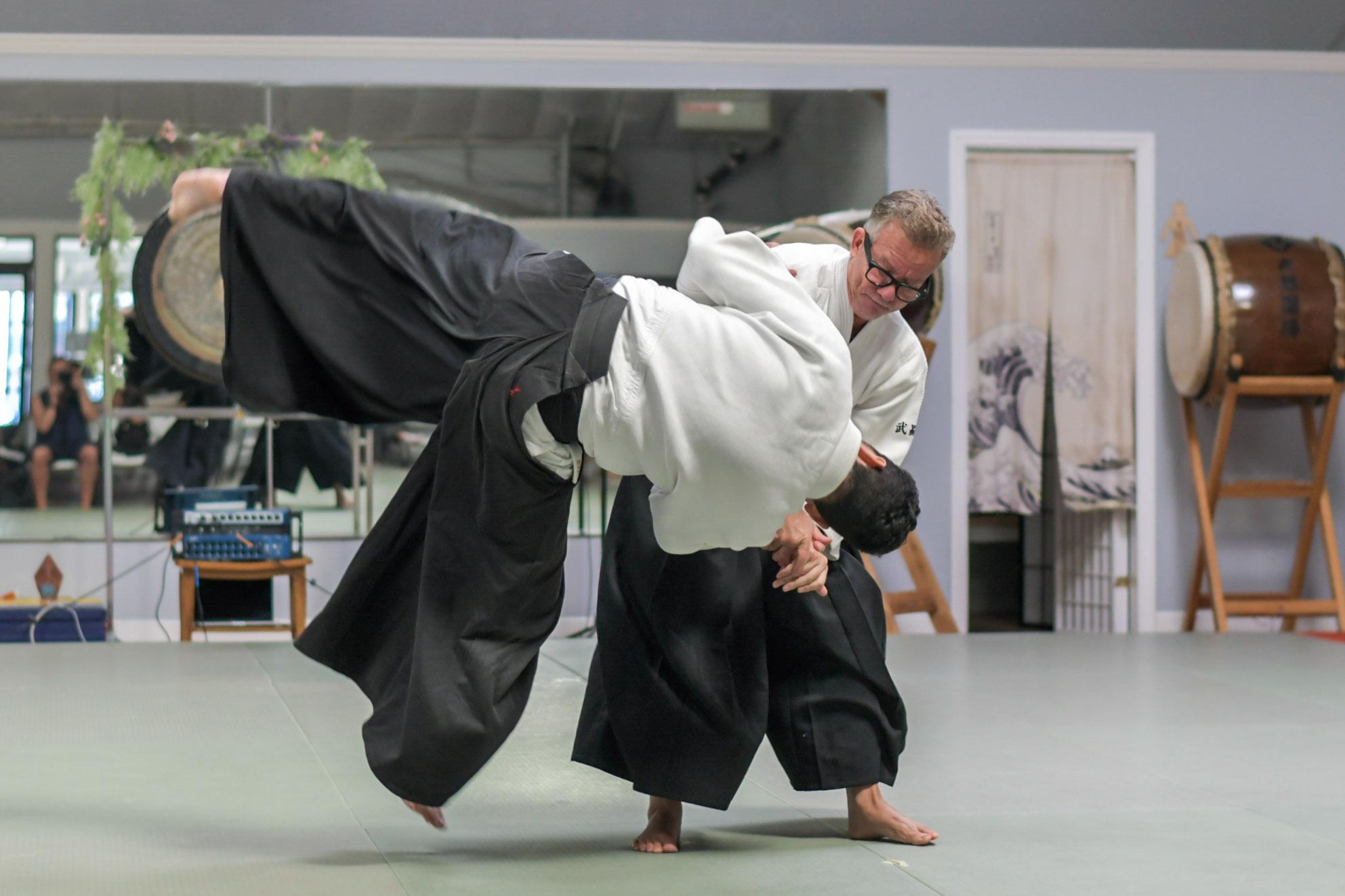
Recently, I participated in a demonstration alongside several high-ranking instructors and students. Watching the demonstrations and evaluations reminded me of something many beginners do not realize.
When senior instructors observe a student, they are not looking first at technical perfection.
They look at etiquette.
They look at spirit.
They listen for kiai.
They observe attitude, awareness, and presence.
Only then do they evaluate the techniques.
In many ways, technical ability comes last.
Why?
Because techniques can be taught. Character must be developed.
A beautiful throw performed without respect, humility, or spirit is ultimately incomplete. On the other hand, a sincere student with strong character and a willingness to learn will continue to improve for years.
This is one of the reasons Aikido can be so transformative. It rewards qualities that extend far beyond the mat.
As a dojo owner, there was a time when I took it personally whenever someone quit training. I would ask myself what I could have done differently. Was the instruction not good enough? Was the class not engaging enough?
With time and experience, I have come to understand something important.
Not everyone who walks through the dojo doors is ready for what Aikido asks of them.
Some are looking for quick results.
Some are looking for entertainment.
Some are simply not ready to be challenged in the ways Aikido challenges us.
And that is okay.
The dojo is not a place that changes people by force. It simply provides an opportunity. Each person must decide whether they are willing to accept the invitation.
The techniques we learn in Aikido are valuable, but the personal growth is priceless. Every class gives us an opportunity to become a little more patient, a little more humble, a little more aware, and a little more resilient.
The dojo is not simply a place to learn martial arts.
It is a place to learn about ourselves.
And that is why Aikido can be challenging.
Not because the techniques are difficult.
But because self-reflection is difficult.
The mirror does not lie.
For those willing to look honestly, however, the rewards are remarkable.
Aikido teaches us that respect matters. Discipline matters. Gratitude matters. Character matters.
These are not old-fashioned values.
They are timeless values.
And in a world that often seems to need them more than ever, they may be among the most important lessons we can offer our children, and ourselves.
Aikido is for everyone.
But first, we must be ready to meet the person looking back at us in the mirror.